The continuing saga of South Africa’s dwindling gun owners provides a case study of what gun-banners want to do in the United StatesAmerica's 1st
Freedom, March 2010
By Dave Kopel
When not banning guns outright, the gun prohibition lobbies—both in the United States and abroad—promote gun owner licensing as a “reasonable” and “sensible” regulation. Yet, the terrible experience of South African gun owners shows how purportedly “reasonable” licensing can be used to devastate a culture of responsible gun ownership.
Most of what has been done to South African gun owners is already being pushed in the United States: gun rationing; targeting the poor and people of color; making gun ownership unaffordable; confiscating guns without compensation; and implementing a licensing system that can be deliberately abused in order to stop good people from owning guns.
Add to this list a government that plays a leading role in arming violent criminals, and you have the deadly disaster of today’s South Africa.
The mechanism for gun rights destruction was the Firearms Control Act (FCA), passed in 2000 by the South African Parliament. The key force behind the bill was Gun Free South Africa, one of the many global gun ban lobbies funded by George Soros.
The governments of Canada, Japan, the United Kingdom and New Zealand provided advice on the draft law, as did Wendy Cukier, head of Canada’s gun prohibition lobby.
South Africa has a long tradition of shooting sports. The first record of an organized sporting event there was the “parrot shoot,” an annual event that began in Oct. 1686. Borrowing from a European tradition in village fairs, Dutch settlers shot at clay or wooden replicas of
birds, known as “papegaij.”
Unfortunately, South Africa developed a comprehensive series of racial caste laws, formalized in 1948 as “apartheid.” Whites had the most rights, followed by “coloureds” (immigrants from Asia), with blacks at the very bottom.
One of the first steps in dismantling this evil system was led by South African gun owners. In 1984, the apartheid government proposed limiting the number and types of firearms that individuals could own. Anew citizen organization, the South African Gunowners’ Association (SAGA, www.saga.org.za), was created to fight for gun owner rights—and they defeated
the government plan.
SAGA did not stop there. The group began pushing to fix the gun laws so that non-whites would have the same rights as whites. SAGA won this fight in Parliament. However, many police administrators abused their powers and thwarted gun license applications by blacks.
Finally, in 1994, apartheid came to a long-overdue end when South Africa held its first multiracial free elections.
Control of the government passed to the African National Congress (ANC), which was fighting a revolutionary war for much of the century. Since then, South Africa has been ruled by the ANC, and year by year the ANC comes more and more to resemble the former apartheid regime.
Like the apartheid regime, the ANC props up a network of allied dictatorships in southern Africa. Without the support of the ANC, Zimbabwe’s genocidal tyrant, Robert Mugabe, would not still be in power.
Like the apartheid regime, the ANC controls the South African Broadcasting Corporation’s radio and television stations, keeping them in conformity with ruling party ideology, and using the license system to exclude alternative viewpoints.
At the United Nations, the South African delegation protects its tyrannical allies (such as Mugabe and the military junta in Burma) by protesting against outside interference with governments that abuse human rights. The current South African delegation’s arguments are nearly identical to the arguments that the apartheid regime once used when it insisted that foreigners should remain silent about oppression in South Africa.
And like the apartheid regime, the ANC is an enemy of gun owner rights in general, and of black gun owners in particular.
The Firearms Control Act of 2000 rationed gun ownership—no more than one self-defense gun per person and no more than four guns total. The lifetime limit on gun ownership is the logical extension of current efforts by American anti-gun lobbies to ration firearms with
“one-handgun-per-month” laws.
All guns must also be registered—the better to enforce the ownership caps.
Semi-automatic long guns are not allowed, except for farmers and a few other special categories. The lone self-defense gun must be a handgun or a manually operated shotgun.
At its outset, about a third of gun owners had more guns than the FCA allowed, so they were required to sell the guns or surrender them to the government. Section 137 of the FCA expressly promised that compensation would be paid to people who surrendered their excess guns—either
because they had “too many,” or because they were enticed by one of the government’s voluntary gun surrender programs.
More than 600,000 guns have been given to the government, yet the government has yet to pay a penny. In 2005, National Police Commissioner Jackie Selebi declared, “You can’t be paid for doing away with an evil thing.”
The new licensing system went into effect in 2004, applying immediately to new applicants. People who had licenses under the old system (the former Arms and Ammunition Act were divided into groups based on date of birth, and required to apply for new licenses starting in 2005. The final set of applications was due on June 30, 2009.
To obtain a gun license in South Africa, one must pass a written “competency test.” The South African constitution recognizes 11 official languages, but the test is only given in two of them, Afrikaans and English. Imagine if your gun ownership rights depended on passing a written test
in a language you could not read!
Applicants are not issued licenses if they are deemed to be at risk of becoming violent. As enforced in South Africa, this could simply mean that a person was divorced, separated or fired within the past two years.
Processing of applications is very slow. For example, of the applications submitted in 2006, only
about a quarter have been fully processed.
Licenses are valid for two, five or 10 years, depending on the legal category of the license, so keeping a gun can mean staying on a near-constant treadmill of paperwork, fees and uncertainty. The majority of the 2005 applicants, who are supposed to renew in 2010, are
still waiting for a decision on their 2005 applications.
Note that complying with all the laws is no guarantee law-abiding people will be able keep their guns. South Africa now has what Sarah Brady, head of the Brady Campaign, described as her long-term objective: “needs-based” licensing. (New York Times, Aug. 15, 1993.) You
get to buy or keep a gun only if the government decides that you need it. In South African law, the formal term is “good motivation.”
Safety and Security Minister Charles Nqakula wrote in a letter to the Gun Dealers’ Association: “Licenses for firearms should not be granted to private individuals.” Similarly, his spokesperson Lesley Xinwa announced, “We are determined to cut down on the number of guns in the country.”
Many license applications are denied, particularly for blacks and others who wish to own self-defense firearms. The Central Firearms Registry (CFR) refuses to say what actually constitutes a good “motivation” for a self-defense firearm. Instead, applications are rejected with
the terse verdicts “lack of motivation” or “insufficient need.”
Married women who want guns for protection are told that their husbands will protect them—as if South African woman should behave like Taliban wives, and never leave the home except with their husbands. People who live in high crime areas are told that the police will protect them—except that the police obviously don’t, as South Africa is one of the most crime-ridden
countries in the world.
Adults who are less than 27 years old are told that they are too young—even though the FCA sets the gun ownership age at 21 (an increase from the old law, which was 16).
Ownership of a firearm without a license is punishable by up to 15 years in prison.
The results have been catastrophic. From 1999 to 2007, the number of legal gun owners fell by 44 percent, according to the South African Police Service (SAPS). Now, only 5 percent of South Africans legally own guns.
The ANC claimed that the FCA would not cause any job losses. Yet in 2004, just two years after the law went into effect, the number of gun stores plunged from 600 to 200.
The government originally claimed that administration of the new law would cost taxpayers 270 million Rand (about 34 million U.S. dollars). But by the time the act was implemented, the true cost had risen to about 263 million U.S. dollars. The millions wasted on the licensing bureaucracy could have been spent actually protecting citizens.
Blacks suffer most under the restrictive licensing program.
“The situation is running out of control,” Abios Khoele, chairman of the Black Gun Owners Association of South Africa (www.bgoasa.co.za), told the Sunday Times. “We blacks only want arms for self-defense—after all, crime is worst of all in the townships [segregated slums created by the apartheid regime]. The trouble is that the government is clearly targeting white gun owners and they really aren’t the problem anymore. The extremist white right is dead and buried. It’s criminals—murderers and rapists—who we have to defend our families
against.
“For most of the apartheid period, blacks weren’t allowed to own guns, and now a black government is taking away our right to self-defense. … The criminals are extremely well armed.”
Khoele sees the disarmament of blacks as a ploy by a government that is afraid of poor people because of the government’s failures on jobs, housing and services.
“White people want more firearms for sport, and black people only want one gun for self-defense,” Khoele notes. “In our townships, it is not safe at all, especially for people who are taking early transport to work, when it’s still dark and they’re walking a long distance.”
In truth, blacks do not enjoy the security of whites, who often live and work in enclaves with electric fences and high walls.
Undefended by the police, and not allowed by the government to obtain a gun license, many blacks are getting guns anyway, just to protect themselves and their families, observes Khoele.
“Most of the people, they’ve already started to buy illegal firearms,” he told The New York Times in 2005. “Most of them are for self-defense, because they’re living in areas where the police are
unable to protect them.”
The result of the FCA has been to help create a thriving underground market in illegal guns. On the streets, a small pistol can be bought for 25 U.S. dollars, or an AK-47 for 100 U.S.
dollars. In contrast, a legal gun costs about 500-625 U.S. dollars, plus more than 125 U.S. dollars for fees and mandatory training.
One can understand why desperate, decent people would obtain a gun illegally. The police take hours to respond to burglary calls. Sometimes a burglary victim who has captured the burglar may be told to take the burglar to the police station himself, because the police cannot send
someone out.
The gun prohibitionists maintain that legal gun ownership must be drastically reduced because legal guns are stolen by criminals. Yet since the FCA mandates that guns be stored in safes, there is no good rationale for banning guns.
Moreover, police claims that criminals' guns are stolen from law-abiding civilians are often conjectural. If a criminal’s gun has an obliterated serial number, the police rarely conduct the difficult forensics of restoring the number. Instead, they just assert that the gun must have come from a licensed civilian owner.
The leading opposition party in South Africa is the Democratic Alliance (DA), which grew out of the anti-apartheid movement. The DA is a staunch critic of the ANC’s campaign against gun owners. Dianne Kohler Barnard, the DA’s spokeswoman on safety and security issues, rebuts the
stolen-gun pretext for citizen gun bans. She points out that in 2008, the recovery rate for stolen guns was 106 percent—meaning that the police recovered more guns than were stolen, and cut into the pool of guns that had been stolen in previous years.
In contrast, the recovery rate for stolen police guns is only 15 percent. In 2008, there were 2,944 police guns reported stolen, and most of them remain in criminal hands. Similarly, of the guns owned by municipal governments, 8 percent (1,260) have been lost or stolen.
“The country is not awash with criminals holding civilian guns, but with criminals holding police guns,” Kohler Barnard told Cape Argus last October. “We must just sit in our homes unarmed while they [criminals] come with police guns to kill us.” Similarly, of the guns owned by municipal governments, eight percent (1,260) have been lost or stolen.
Kohler Barnard points out that many citizen’s guns that were surrendered to the police have later been used in armed robberies, apparently after being sold by corrupt police.
SAPS says that from April 2006 to March 2007, there were 14,682 civilian firearms reported stolen. That’s out of 2.5 million licensed firearm owners. In other words, one annual gun theft per 170 gun owners, which is a high rate by global standards.
Contrast that with the nearly 3,000 guns stolen from South Africa’s police in a one-year period—one stolen gun per 47 officers. And then there are the many incidents in which citizens gave guns to the police for safekeeping—for example, when a citizen going on extended vacation wants to make sure a gun is not stolen from his home. When attempting to reclaim them
later, citizens are often told their guns are "missing" (The Citizen,Sept. 21, 2007).
Simply put, the single largest supplier of criminals’ guns in South Africa is the South African government. As one businessman told All Africa in 2006, “There are many cases where serving
police officers and soldiers have been found among gang members in cash-in-transit heists and bank robberies.”
Johannesburg’s Sunday Times reported “…there is a huge leakage of weapons from the army and police, who often sell them at a profit. Another source [of criminals’ guns] is homemade guns, turned out in township backyards.”
Many South African criminals use automatic carbines (the R5 and predecessor models), which are the main small arms of the South African National Defense Force. These guns are not legal for civilian ownership.
Who owns the very biggest arsenal of unregistered, unlicensed guns? The African National Congress itself.
The ANC is thought to retain 100 tons of weapons and munitions, left over from its days as a revolutionary army. No one knows how many of these have been sold to criminals. The ANC has never explained why—15 years after it took power in a democratic election—it remains the only political party that has the capability to raise a private army.
During the war decades before 1994, both sides supplied huge quantities of arms to their allies and proxies, in the Republic of South Africa and in nearby countries. Now, many of these guns are flowing past South Africa’s porous borders, to supply the criminal black market.
Khoele, of the Black Gun Owners’ Association, told the Sunday Times, “The ANC smuggled huge numbers of guns into the country and after liberation made no effort to collect them back. Those same weapons are now often used in holdups.”
It is South African governments, past and present, which have supplied the criminals’ guns, and then blamed gun crime on law-abiding gun owners.
South Africa still has an independent judiciary. A decision this summer by the Western Cape High Court ordered the government to pay the legally required compensation for surrendered guns, although whether the government will do so remains uncertain.
It’s important to note that Gun Free South Africa started its offensive against gun ownership by convincing businesses or othe organizations to declare their property “gun free.” The businesses certainly had the right to choose to do so, but they ended up becoming pawns in GFSA’s
long-term campaign to destroy all choice about gun ownership and to make the entire nation of South Africa “gun free.” Or rather, “free” only of guns owned by law-abiding citizens.
Of course, we understand that “gun-free” zones often become killing zones. That is what happened in Rwanda in 1994, where the defenseless genocide victims were “gun free.” That is what is happening today in Zimbabwe, where everyone except Robert Mugabe’s criminal government and its allies is “gun free.” That is what is happening right now in South Africa’s
impoverished townships, where robbers armed with government-supplied guns routinely murder their defenseless victims.
Is there hope for South Africa? Two-thirds of South Africans believe they have a right to own a gun (Financial Mail, Aug. 31,2000), as indeed they do, since human rights are inherent even when governments refuse to respect those rights.
Although the ANC has been steadily consolidating power and removing constitutional checks and balances, South Africa for now remains a democracy, with a free printed press, uncensored Internet and strong opposition parties who stand up for the self-defense rights of South Africans of all races.
The ANC’s Safety and Security Ministry spokesman,Trevor Bloem, told the Associated Press in 2006, “Gun control is here to stay across the world, including in the United States. Anything else would lead to chaos.”
He is being proven wrong about the United States. And he may be wrong about South Africa, for it is the mean-spirited, dishonest and irresponsible gun-control policies of the ANC that are devastating the rule of law and leading to chaos in South Africa.
http://www.davekopel.com/2A/Foreign/South-Africas-Deadly-Disaster.htm

Crime is Crime Corruption is Corruption Murder is Murder Rape is Rape Facts are Facts
Thursday, September 8, 2011


National Crime Statistics 2010 - 2011
Remarks by the Minister of Police, E.N. Mthethwa, MP on the occasion of the release of the National Crime Statistics,
Sheraton Hotel, Pretoria, Gauteng
08 September 2011
Deputy Minister of Police, Ms MM Sotyu;
All MECs responsible for Safety present;
Chairperson of the Portfolio Committee on Police, Ms S Chikunga;
National Commissioner of Police, General BH Cele;
All SAPS Lieutenant Generals, Senior Officers and Staff present;
Statistician General, Mr P Lehohla;
Secretary for Police, Ms J Irish-Qhobosheane;
Chairperson of the PSIRA Board, Mr P Bopela;
Executive Director of the ICD, Mr F Beukman;
Chairperson of the National CPF Board, Mr M Mphuti;
Representatives from Business, Unions and Civic Organizations present;
Distinguished Guests;
Members of the Media;
Ladies and Gentlemen;
2011 remains “A Year of Action: Ensuring That All People In South Africa Are, and Feel Safe.”
The current government has identified five key priorities and amongst them, is the issue of fighting crime and fighting the causes of crime.
In brief, our programme in this period consists of achieving better policing, a better-trained and efficient criminal justice system, involvement of society in the fight against crime, and a campaign to refurbish the moral fibre of the South African society.
In dealing with issues of crime, the government proceeds from a premise that: a rising quality of life also means improvement in the safety and security of citizens in their homes and environs where they live, work and engage in extramural activity.
The battle against crime cannot be separated from the war on want. In the main, incidents of contact crime such as murder, grievous bodily harm and rape occur among acquaintances in poor communities where living and entertainment environments do not allow for decent family and social life.
Fellow South Africans,
The release of the South African Police Service (SAPS) crime statistics for the period 1st April 2010 to 31 March 2011 cannot be equated to an occasion about statistics, numerics and graphs; rather as a reflection on the path we have traversed in the past twelve months.
This occasion affords us to gauge whether the strategies and systems we put in place are yielding the desired positive results. The fundamental aim of our government is therefore to build a society where people will enjoy a dignified, improving quality of life and freedom. However crime stands in direct opposite of achieving this goal.
Inevitably, freedom does not create itself. Crime does not simply disappear; we must create conditions that will make crime disappear. This requires a concerted, united action by all South Africans.
The crime statistics for 2010/11 that are being released here today clearly show that we are making progress in some areas, there are instance where we are reaching stability and there are types of crimes which are still a challenge. To this end, it is important to emphasize that our crime statistics have been audited.
We also engaged a number of different role-players to compare their experiences with regard to certain crime types. We have noted that there is convergence on our crime statistics with the stakeholders, in this field be they business, tracking and insurance.
Decrease in Contact Crime (Crimes against the person)
Contact crime is an area of crime which by its nature leads to serious feelings of fears of insecurity because it is this form of crime with which violence is normally associated. This contact crime also accounts for roughly one third of all crimes.
We are therefore encouraged to see that, for the 2010/11 financial year, contact crime generally decreased by 6,9% and that all provinces with the exception of North West and Western Cape, showed a decline in this form of crime. In fact all seven categories of contact crime witnessed a decline (this refers to murder, attempted murder, sexual offenses, assault Grievous Bodily Harm, assault common, aggravated robbery and common robbery).
Decrease in Trio Crimes
Linked to the decrease in contact crime are the successes we achieved with regard to the trio crimes (that is house robberies, business robberies and vehicles hijacking) and we note in a positive light the 10,7% decrease in trio crimes.
Decrease in Murder
Murder is one of the most reliable form of crime statistics and during 2010/11 the figure has dropped below the 16 000 figure; with 15 940 cases being recorded. We are encouraged to see the murder ratio decreasing by 6,5%.
It is perhaps worth mentioning that during the 1994/95 period our murder ratio as a country stood at 27 000. We further recognize that dealing with this sort of crime is not only dependent on police but it is a societal challenge which requires a coordinated effort. These continuous reductions in murder indicate that government is succeeding in its efforts.
Decrease in Attempted Murder
During the 2009/10 financial year as we reported, attempted murder decreased by 6,1% and we are pleased to see a further improvement in this category. During the 2010/11 financial year, we have witnessed a 12,2% decrease in this category.
Decrease in Sexual Offences
One area that still requires our attention is that of sexual offenses. While we are happy that this category generally has declined over the last two years, were remain concerned about the number of rapes that occur in the country.
During the fiscal under review, the sexual offences ratio decreased by 3,1%. The number of reported cases of rape still remains unacceptably high; especially in lieu of the fact that such crimes have a lifetime negative on victims. In addition we need to ensure that victims of such crimes feel safe.
Rape increased from 55 097 to 56 272 cases and we cannot seriously say we are winning the war against rape. We have however taken various steps in addressing this scourge.
The re-introduction of the Family Violence, Child Protection and Sexual Offences units throughout the country over the last financial year provides us with the platform on which to ensure crimes against women and children are adequately addressed by the police.
But the reality is that rape, based on international trends, is often under-reported but as we continue to improve our Criminal Justice System, we could see more reporting by victims. After all, the eradication of violence targeted at women and children remains one of our key priorities.
Decrease in Assault with intent to inflict GBH
During our reporting back to the nation last year, we announced that this category had experienced a 0,5% decrease. During the 2010/11 financial year, we have seen a further decrease with a 4,5% ratio on the assault with the intent to inflict grievous bodily harm.
Decrease in Aggravated Robberies
We are encouraged by the constant decline in aggravated robberies over the last two years. We believe that some of our initiatives in addressing this form of crime are starting to yield success but we shall continue to work harder and smarter, to reduce this form of crime. During the current fiscal the robbery with aggravating circumstances ratio decreased by 12,0%.
We believe that improvements in both our detection and conviction rates are as significant contributing factor to this decline; as is our approach to increasing police visibility and targeted visible police interventions. In addition the strong emphasis we have placed on building partnerships has also impacted positively on such crimes.
Decrease in House Robberies
Two years ago when we released our 2008/09 crime statistics, we expressed concerns regarding house robberies, which had increased dramatically.
At the time we committed ourselves to developing and implementing measures to reduce house robberies. Last year this form of crime began to show signs of stabilizing as we began to avert the continued steep and upward trend.
During the 2010/11 financial year for the first time in since 2004 the number of recorded cases started to decline significantly, with a 10,1%, from 18 786 reported cases last year to 16 889 cases for the fiscal under review.
Our engagement with the Insurance industry reflects that they too have started to witness the impact of this decline. According to the South African Insurance Crime Bureau different insurance companies are experiencing a decline in the range of between 4% and 31%.
Decrease in Car Hijackings
Another area where the tide is beginning to turn against criminals is in the area of car hijackings. For the last three years this form of crime was starting to gradually increase.
Over the last two years we have been able not only to stabilize this form of crime but our figures for 2010/11 are the lowest seen since 2003/04. For the first time in eight years the figure has dropped below 10 700. For the 2010/11 financial year, car hijacking decreased by 23,6%.
During engagements with both Tracker companies and the South African Insurance Crime Bureau they indicated that they were also experiencing significant decline in cases of theft of vehicles.
Decrease in Truck Hijackings
During the 2010/11 financial year, truck hijackings decreased by 29,2% with 413 cases recorded in comparison with a 1,7% the previous financial year, that is, 2009/10.
Decrease in Burglary at Residential Premises
During the 2009/10 financial year, the burglary at residential premises ratio increased by 2,7%. To address this challenge, we undertook to capacitate the Private Security Industry Regulatory Authority, to further complement this industry’s cooperation with police.
For the financial year under review, that is 2010/11, the burglary at residential premises ratio decreased by 4,8%. We can attribute this improvement amongst others, the success of ‘Operation Duty Calls’ festive season campaign.
Increase in Non-Residential Robberies
The organized business sector continues to experience decreases in robbery.
From 2005 – 2008 there was a massive steep increase and from last year there we witnessed a stabilizing trend of this crime category. For the 2010/11 financial year, there was a 0,9% increase in non-residential, particularly on smaller businesses, spaza shops, super markets, taverns, schools and general dealers.
Last year we informed the nation that we were working on a pilot-project to address small business robberies. This is a difficult area to manage and secure because of the capacity to do as big business do. Now, based on this persistent challenge in smaller business, we are developing a National Small Business Robbery Strategy which will be finalized by the end of this year and then be rolled out across the country.
Decrease in Cash-In-Transit
The detection and arrest of key criminals involved in bank and Cash-In-Transit robberies coupled with our rapid response to such crimes and our partnerships with the business community; has continued to result in declines in this form of crime.
The decision to allow the printing of photographs of criminals wanted for such crimes has also contributed to an increase in the number of arrests made. We are therefore pleased to see a massive decrease of 18,7% for the 2010/11 financial year, from a 7,3% in the 2009/10 financial year.
Decrease in Bank Robbery
Again through coordinated efforts with our partners from Business we have witnessed one of the biggest improvements in our crime statistics for the year under review. Bank robbery decreased by 58,1% with 93 cases recorded in 2009/10 to 39 for the 2010/11 financial year.
Decrease in Stock Theft
Since 2008 one form of crime which has deeply concerned us is the increase in stock theft. Whilst we are encouraged that there has been a decline of 8,2% in the number of reported cases of stock theft during the past fiscal, we are still not really happy with the situation.
Not only are the figures still too high and the impact to serve but we also need to make sure that the decline is not a result of possible under-reporting. Late last year we launched the Rural Safety Strategy and now need make sure that this strategy draws in farm-workers, commercial and small farmers as well as local rural communities themselves.
Farmers, farm-workers and residents within rural communities are considered soft targets by criminals. This is due to the remoteness of farms, high market value of properties, large distances between farms and villages and the inaccessibility to the police as well as basic infrastructure, such as roads. Rural police stations are often isolated and responsible to police vast areas.
Decrease in illegal possession of firearms and ammunition
Although the illegal possession of firearms ration decreased by 2,0% during the financial year 2010/11, we are still concerned about the continuous loss of firearms both in hands of police and civilians.
The department has over the last 18 months been putting in place measures to reduce the number of firearms stolen or lost by SAPS members. These include IBIS testing of all firearms, stricter controls on reporting, checking of firearms as well as improving sanctions procedures and processes in instances where SAPS officials lose firearms. We shall continue to be tough on those officers found to have negligently lost firearms, including civilians.
Increase in ATM Blasts
One area of concern to the police during the past financial year was the significant increase in ATM bombings which increased by 61,5%, from 247 recorded cases in 2009/10 to 399 in the 2010/11 financial year.
This massive increase further correlates with the statistics provided by the South African Banking Risk Information Centre. The majority of these blasts took place in Gauteng, with a 57,1% followed by North West with 12,4%.
Some of these trends are informed by migration and displacement of crime from one province to another but we are beginning to intensify our operations in some of these hard-hit provinces.
However despite this massive increase we are encouraged by the fact that a concerted focus on this form of crime is starting yield some successes. According to figures from SABRIC, this form of crime has started to decline with a 17% decline in ATM robberies since April 2011 compared to the same period last year.
Increase in Drug-related Crimes
The drug-related crime ratio increased by 10,2% in the 2010/11 financial year. We are now intensifying our approaches by mounting operations that are aimed at cracking the backbones of drug-lord syndicates instead of focusing and arresting drug-peddlers.
We are also working with other sister departments including Social Development and Basic Education as most affected are young children. We also acknowledge that dealing with drugs is a global challenge that needs to be coordinated with our international counterparts.
Increase in cases of Drunken Driving
In 2009/10 driving under the influence of alcohol or drugs ratio increased by 10,6% and for the 2010/11 financial year, an increase was 4,5%.
In dealing with this crime, it is incumbent upon all South Africans to abide by the road safety laws and as the ministry we will continue to support campaigns such as Arrive Alive. We all have a duty to ensure that our roads are safe and those who break the law, will be severely punished.
Increase in Commercial Crime
The commercial crime ratio increased by 2,8% for the 2010/11 financial year.
As we mentioned during last year’s announcement, it is becoming evidently clear that this crime is not a unique South African phenomenon, but a global challenge. It is our endearing hope that as we partner with our international counterparts, that we will be able to improve in dealing with this crime.
Arrest of 49 of the top 50 most wanted criminals
The following successes were achieved by the Directorate for Priority Crime Investigation (DPCI) for the 2010/11 financial year. In tackling commercial crime, the Hawks arrested 8 294 and secured 5 267 convictions; when it comes to organized crime they further arrested 2 439 and secured 532 convictions.
During the period under review, the Directorate profiled and pursued 50 most wanted suspects for armed robberies, ATM bombings cash-in-transit and bank robberies. They apprehended 49, and they are in hot pursuit of the 1 one elusive scoundrel who is still at large.
More Arrests, More Detection, More Convictions
To effectively deal a blow to crime, we have as the police leadership emphasized to police management that they need to secure more and more convictions. Unless we attain these our efforts will not yield the desired results.
Many of the suspects arrested would have been involved in more than one crime incident and some instances one individual would range from 35 to 50 incidents. It is also premised on the reality that the majority of South Africans are law-abiding citizens and that the majority of crimes are committed by a small group of people are repeat offenders.
Decrease in Police Deaths
On a sore note, each financial year we come before the nation to sadly announce men and women in blue who lost their lives – in pursuit of safeguarding us. In the 2009/10 financial we announced that 110 police officers passed away in the line of duty; this financial year, 2010/11 there was a slight decrease as we lost 94 police officers.
We are also concerned about the increasing attacks and killings of our officers since the beginning of the year; but remain confident that as we work with all our partners, we will be able to defeat these heartless criminals.
These heroes remained fearless for they knew that their duty was to the society and their mission was to wage a war against crime. By taking a stance against crime and all its evils, this can be the best memory we can afford these heroes who put their country’s welfare above their own.
Improving the SAPS to effectively fight crime
The transformation of the police must across the country, focus on the type of Police Service we want to see. It must ensure that our Police Service at all levels is reflective of the society it polices and the values we wish to promote within our society.
The current review process of the White Paper for Safety and Security will therefore guide our approach to the overall transformation of the police.
Improving the police response is an objective that remains a priority for the department. The equitable distribution of police stations is essential in ensuring that the services provided by SAPS in support of safe and secured communities is to be realized by all people.
Critically, focus must be placed on mobilizing society to make life difficult for criminals in our midst. This should include an overhaul of gender and family relations and intolerance of abuse within communities.
Alongside our operational approaches we shall ensure that there is a concerted focus on human resource development from recruitment to retirement and to ensure effectiveness of our service delivery at all levels within the police.
Conclusion:
The 2010/11 financial year crime statistics confirm our assertion that indeed the tide against crime is turning and that police, joined by society are gaining an upper hand against vicious criminals. The statistics however, should serve as a motivating factor and encouragement in all our efforts.
Training is also a crucial part of our approach to improving policing. We have now revised how and what is involved in training. Our training must tackle both the content and the manner in which we train. Training cannot be just about churning out numbers but must be ongoing and relevant.
Victory against crime is now an achievable goal. However for as long as young children are still under the bondage of crime and drugs; for as long as businesses are robbed, for as long as women are abused and raped, for as long as South Africans across are mugged and hijacked – none of us can must rest.
The war on crime must continue; a war by the way, that has been declared by heartless criminals on law-abiding citizens. Cautiously, these year’s crime statistics tell us that we must never be complacent and say our work is done.
We all have a duty to make categorical commitment to work even harder to indeed give true impetus to government’s undertaking that: “All People in South Africa Are and Feel Safe.”
Wednesday, September 7, 2011
Out of Africa
 Chris McGreal began reporting from Africa at a time of profound change. He witnessed both the unbridled optimism of Nelson Mandela's release and the horrors of the Rwandan genocide. Two decades later, in his final dispatch, he relives the moments that affected him most deeply, and asks what the future holds for this great continent.
The world swooned as the great man was sworn in as president a few days later and the white generals, who had built a fearsome military and battled across the hinterland of southern Africa to avoid this day, turned to salute him. True, the ideal of the "rainbow nation" was more a vision than an expectation, some might say a self delusion, given South Africa's knotty mix of race and history. Yet the belief and hope of those years was contagious and the infection spread across Africa.
But running in parallel were the worst of times. Weeks after watching Mandela vote, I was standing at a church among thousands of corpses rising from the ground. It was about 3am and I had just listened to a small group of nuns in the Rwandan town of Kibuye describe the massacre of thousands of Tutsis in the Roman Catholic church. Eleven thousand died there in a single day. Another 10,000 were murdered in the football stadium the next.
The bodies were swiftly buried around the church but rains washed the soil away, and everywhere the remains of people frozen in futile defence against bullets and machetes were emerging from the soil. Women, children, old men - no one was spared, not even the priest. Bullet holes speckled the church's corrugated iron roof. In the backrooms, bloody handprints adorned the walls.
I had met the man responsible for all this a few hours earlier. Clément Kayishema was a doctor and, at one time, head of the local hospital, but by the time of the genocide he was a political force as the governor of Kibuye province. When I turned up in his town, he directed that I be held in a hotel-turned-barracks. One day he would have cause to regret that.
I had arrived in Africa four years earlier, not really knowing what to expect. As I was growing up in the 70s, news from Africa was dominated by Idi Amin and Ian Smith, whose stand for white rule in Rhodesia was amply justified in my parents' eyes by Uganda's bloody tyrant. Anti-apartheid boycotts were beginning to take hold, even if there was still widespread sympathy in Britain for the white regime in Pretoria. The mood hardened with the beginning of the Soweto uprising and the state's brutal response a few years later. The long war in Angola was brought to our living room principally through the trial of British mercenaries, as Washington and Moscow fought out their cold war at the cost of African lives. It was only about a decade after independence for most countries, but already the continent was being written off as a basket case run by buffoons and thieves.
That was then. I was landing in 1990 in what promised to be a very different Africa. Alongside the fall of apartheid, the talk was of a "new breed" of African leaders rejecting corrupt, authoritarian one-party regimes preying on their own people. Britain was flinging money at Uganda's new ruler, Yoweri Museveni - a paragon of leadership compared with Amin - who promised not only clean, accountable government but adherence to the prevailing western orthodoxy of privatisation and free markets. Other great hopes would follow: Ethiopia's Meles Zenawi and Rwanda's Paul Kagame.
The expectation infecting South Africa was creeping north, sometimes forcing out the old but always bringing some kind of change. People turned out in their tens of millions to vote, waiting in lines for hours in Zambia, Angola, Malawi, Nigeria, Zimbabwe with enthusiasm and humour for the chance, at last, to have a say in who governed them. They spoke of a new era, an end to war, corruption and the oppressive "presidents for life" who claimed the right to rule perpetually because they had liberated their countries from colonial subjugation. Promise was all around.
But then the new breed often turned out to be like the old breed, and the old breed clung on for dear life where it could. Angola was flung back into war.
Nigeria's army didn't like the election result and imposed its most brutal dictatorship to date. The new rulers of Zambia and Malawi proved to be as corrupt as their predecessors. In Zimbabwe, the first election that posed a threat to president Robert Mugabe's power marked the beginning of a decade of decline and bloodshed that is still frustrating the will of its people.
Calamitous failures of leadership left millions dead and perpetuated the struggle for existence of millions more. Even South Africa, where the courage of FW de Klerk and Mandela had seen a nation reborn, watched its new democracy eroded by the authoritarian and sometimes paranoid leadership of president Thabo Mbeki.
Books have been filled with the shortcomings of African leaders since independence, from the corrupt "big men" and military rulers propped up by the west because of their anti-communist credentials to the former Marxist leaders who wallow in the money they made selling off the state assets they once seized in the name of the people. Yet, after two decades of watching failed leadership, the Africans that have made the greatest impression on me are the extraordinary individuals who stood against that tide.
In South Africa there is Zackie Achmat, an HIV-positive gay Muslim man of Indian extraction and ANC member, who led the campaign against Mbeki's perverted denial of life-saving anti-Aids drugs to poor black people. In doing so, Achmat did much to keep democratic accountability alive under governments that have badly subverted the institutions of the country's new democracy, particularly the judiciary, while corruption flourishes.
Other names are less well known, such as those of the women in eastern Congo who venture into the most dangerous areas to rescue other women from years of systematic mass rape by the gangs of armed militias that amount to the only form of authority over vast territories. Or the Nigerian journalists who risked assassination or long sentences in hellish prisons to expose the truth about the military dictators plundering their country. Not a few were murdered or slung in jail by military courts.
And there are those who names cannot, for now, be revealed. They include the Zimbabwean doctors who have for years lived with the risk of arrest, torture and even death to run an underground railroad to help the victims of Mugabe's sustained and bloody terror against his people. Thousands of the beaten and near-dead have been rescued and spirited to private clinics, secretly operated on and kept beyond the clutches of the intelligence organisations.
Sometimes whole groups of people proved heroic in their own way. White South Africans, particularly the all-too-often vilified Afrikaners, set aside fear and years of indoctrination to support the transition to black rule in a referendum. It was a huge leap of faith - albeit one made in part out of desperation at the realisation that their country was otherwise headed for the abyss.
But of all the silent heroes, perhaps none was more unusual than Sosthene Niyitegeka. The Hutu shopkeeper and pastor risked everything - his own life and that of his wife and children - to save every Tutsi in his village at the height of the Rwandan genocide, with a plan that mixed appeals to human decency with blackmail and infiltration of the militia leading the killing. Niyitegaka's story is extraordinary because Rwanda stands apart. There have been plenty of other mass graves across those two decades and before. But Rwanda left a different mark. It offered the darkest insight into the fragility of society, and it is the legacy of that tiny country's genocide and its tragic failures of leadership that a good part of Africa continues to live with today.
My encounter with Clément Kayishema in Kibuye was brief. He happened to be in the main square when I arrived and he asked what I was doing there. I tried to fob him off with something about assessing the refugee situation, but he ordered some soldiers to hold me in a crumbling lakeside hotel taken over by the army. The soldiers drank through the evening and passed out.
I slipped away in the night to talk to the nuns, who recounted in detail the events at the church. They told of the mobs armed with machetes, grenades and guns, and how Kayishema had told the priest to walk away or die. Then he led the massacre, wielding a sword. Those who survived the initial onslaught of explosives and bullets were hacked to death or lined up and clubbed one by one. Some of the women were gang raped and had their eyes gouged out. Many of the killers were from the town. The nuns recognised them: teachers, civil servants, policemen, peasant farmers.
After three hours of listening to the nuns, I made my way to the church to see first-hand the evidence and then get out of town before dawn. My four-hour drive to the Zaire border was dotted with roadblocks manned by Hutu militiamen with clubs, machetes and guns; but by then most of the Tutsis were dead, so they were usually more drunk than menacing.
I was back in Kibuye a couple of weeks later. It was a Sunday and the people were shuffling into the church, neat in their best clothes. Someone had tried to scrub the place clean, but the smell of the torrent of blood that seemed to have worked its way under the very skin of the church was still unbearable, and worshippers prayed with cloths held to their faces.
The church had a new Hutu priest. He was available because he had overseen the bulldozing of his former church in another part of Rwanda, with its Tutsi congregation still inside. The priest made no mention of the dead. Some of the worshippers denied there had been a massacre; a woman who said it was all a lie refused to look at a foot sticking out of the ground beside her.
Rwanda was about as catastrophic a failure of leadership as Africa has seen. The genocide has been explained away as the unleashing of ancient ethnic hatreds and the legacy of the European colonial obsession with the spurious science of racial hierarchy, which in this case regarded Tutsis as genetically superior to Hutus. All of that played a role, but the unleashing of what was intended to be the final solution to the "Tutsi problem" was a raw power-play by an educated elite that feared losing control to democracy and power-sharing with Tutsi rebels. An entire government, military and a large part of the population was organised to hunt down and murder hundreds of thousands of people, which they did with remarkable success by killing close to a million in 100 days.
In the following weeks, as the government of murderers retreated in the face of a rebel onslaught, the prime minister, Jean Kambanda, told me how the Tutsis had brought it on themselves. The chief of staff in the defence ministry, Théoneste Bagosora, the architect of the slaughter, attempted to portray the mass murder as a spontaneous bloodletting born of fear and anger that no one could stop.
I met Bagosora a few times, but it was only a few weeks after the genocide that I sat down to talk to him properly. He was in Zaire along with about a million other Hutus who had fled defeat. Perched on his chair, a satellite phone at his side and flashing gold jewellery, Bagosora was unapologetic, belligerent and conflicted. On the one hand he was clearly pleased with his handiwork in organising the slaughter of about 800,000 people. On the other, he needed to maintain the fiction that the killings were a spontaneous outburst of anger against Tutsis. So he settled for questioning that it had happened at all.
"People say Bagosora did this or that, that I have the blood of the Tutsis on my hands. But where are all these people who were killed? If they died it is because they are rebels or because the people were angry with them. They didn't need Bagosora to tell them who to kill," he said. "But it's true that the Tutsis are trouble. Now they have taken over the country, a Hutu country. We will fight them again until all the Tutsis are gone."
Bagosora was a cold, frightening figure. The head of the UN mission to Rwanda described meeting him as like shaking the hand of the devil. Yet, like others who have wielded so much power of life and death, he might in different circumstances have been mistaken for a lowly civil servant.
Out of all this also came Sosthene Niyitegeka. The Hutu, Seventh-day Adventist preacher had a small shop, a wife and nine children to protect. But he saw what was about to occur with moral clarity as the Hutu militia, headed by the village primary school teacher, handed out crate-loads of grenades "like sweets", as Niyitegeka put it.
When a Tutsi woman, a nurse with her children in tow, knocked on his door he let her in. A day or two later there was another woman on his doorstep. She had been stripped naked, carved up by machete and had nearly lost her arms.
Niyitegeka's reputation drew others - businessmen, civil servants, peasants - to his house. "They were the kind of people that, if you hid them, you could get yourself killed for. Some were really desperate. Running by night, hiding by day," he said.
After 10 days he was sheltering 104 people in his house and the maize field out the back. But members of the the Hutu extremist militia, known as the Interahamwe, were watching, and Niyitegeka knew he had to find better hiding places. He appealed to those neighbours he trusted to do the decent thing.
Others weren't so co-operative, but the preacher knew a thing or two about who was sleeping with who - the kind of thing that makes people co-operative. In a daring move, he sent people he trusted to drink in the bar where the militiamen tanked themselves up on beer before beginning their hunt for human victims.
The spies sent back word and, over the following weeks, a sinister form of hide-and-seek unfolded as Niyitegeka moved Tutsis between about 30 houses, always keeping one step ahead of the Interahamwe. Sometimes dozens at a time were hurried into the maize fields or the hills as the militia hunted their quarry.
At one point, Niyitegeka persuaded the local council that the militia members were always drunk and thieving from people's houses, and should not be entrusted with the search for Tutsis. So the council appointed the pastor to lead it, and he appointed a group of friends who were hiding Tutsis to help him. When the rebels arrived and the Interahamwe fled, every Tutsi hidden by Niyitegeka was still alive.
Most Hutus did not take a direct role in the genocide. Many passively opposed the murder of their Tutsi friends and neighbours. But only a few actively resisted it. I asked Niyitegeka why he did it.
"Any person could see this was wrong. How could killing children be right? How could it be right to kill the neighbours you have lived with all your life? But Rwanda is a strange country. People do things because the government tells them to. They do not think for themselves. When these leaders say: 'Kill your neighbours while we get rich,' they do not think that is wrong.'"
I had much the same discussion with another Hutu. Theoneste Nzigiyimana was a bank cashier. A badly battered woman who had been raped and beaten, Madalena Mukariemeria, stepped up to the counter. Behind her was a Hutu militiaman, and Nzigiyimana quickly realised the woman's life depended on her being able to give the armed man money. The cashier looked at Mukariemeria's account and it was virtually empty. So Nzigiyimana withdrew 20,000 francs - just £30 but a large amount in Rwanda at the time - from his own account and handed it to the woman.
In the coming weeks, Nzigiyimana handed over a lot more cash, then took out loans when his own money ran out to help save 10 Tutsis and their families. This at a time where mobs of armed militia were terrorising the population and butchering anyone who helped Tutsis.
"I was seeing the leadership was doing things that weren't good, so in my heart I knew it was wrong," he told me. "These are people we used to share things with, living together, marrying each other, working together."
Rwanda left its mark on everyone, Hutus and Tutsis, peacekeepers and aid workers. Reporters too. I agreed to testify against Kayishema, the governor who organised the massacres in Kibuye, at the international tribunal for Rwanda. The prosecution wanted me for one small thing: to establish that he continued to wield authority at a time when he claimed to have been stripped of power.
There is a debate among reporters over whether we should take the stand at international courts, but it seemed difficult to me, after writing of the blood on the hands of western leaders for abandoning the Tutsis, to then refuse to make a small contribution to what little justice there was for the dead and survivors. Kayishema is serving life in a prison in Mali.
The international tribunal has done a good job of capturing and trying those responsible. Bagosora, the mastermind of the genocide, was convicted and jailed for life along with many of the military and political leaders who oversaw the slaughter. But the trials were protracted and seemed distant to the survivors and those rebuilding their lives.
The Rwandan government came at it differently. A few months after testifying at the international tribunal, I watched three men and a woman tied to wooden posts and shot in public in a Kigali stadium for their role in the genocide. Another 18 people were executed on hilltops across the country before crowds of taunting and cheering survivors. The executions were widely condemned. Some recoiled at the medieval practice of killing people in front of a baying crowd. Amnesty International said they would do nothing for reconciliation in Rwanda. That wasn't the point. Almost no one had apologised for the genocide. The only regret among those who organised it was that they had failed to carry through the extermination of the Tutsis. In the absence of remorse, the survivors wanted a price to be exacted for the destruction of their families. It was hard not to agree with them.
I watched one of those hauled before the firing squad with particular interest.
Froduald Karamira was the leader of a Hutu extremist faction whose call to murder pounded across the airways at the height of the genocide. That he was a Tutsi who reinvented himself as a Hutu and became a fanatic to prove his loyalty only added to the horror. When he wasn't on the radio, Karamira was on the streets killing by example.
I met Karamira a few times and sat through his trial on a wooden bench behind him at a packed and dilapidated old court in Kigali. For three days, he again fascinated and appalled Rwandans with a performance that swung from defiant denial of reality to a taunting of the court, all of it broadcast on the radio. He knew he would be shot, and told the judges he would be happy to die if it made the Tutsis happy.
But the bravado fell away as the witnesses spoke. One listed all the members of his family murdered at Karamira's behest. They included his wife, five children, mother, four sisters and two nephews. I spoke to Karamira some time later in prison. He didn't regret a thing.
He was shot in the stadium in which he had led many rallies denouncing Tutsis, and from which he made some of his radio broadcasts. His execution left me cold. As I thought back on the immense suffering caused by Karamira and his cohorts - the slow tortured deaths by machete, the pain of the Tutsi orphans who could barely comprehend what had happened, the women murdered slowly after they were gang-raped and infected with HIV - my long-held view that the death penalty was wrong, no matter what, fell away. Before Rwanda, I could not have imagined saying this, but I would not have saved Karamira even if it had been in my power. I looked at him and believed he deserved to die.
The genocide, though, proved to be just a beginning. Two million Hutus fled Rwanda as the Tutsi rebels seized power. Tens of thousands died of cholera on a hellish landscape of volcanic rock in Goma, as the sky darkened with ash. It smacked of divine retribution, except that so many of the dead were children.
Africa is still living with the legacy 15 years later. What began as civil strife in a tiny country reverberated across central Africa, bringing down one of the continent's longest standing dictators, Mobutu Sese Seko, and drawing a host of countries into the subsequent wars in the Democratic Republic of Congo. Millions died in the perpetual conflict that followed.
Rwanda had other consequences, too. Guilt over the west's failure to act prompted the British intervention in Sierra Leone that put an end to its rebel war and horrific crimes against civilians. Rwanda went on to become a regional power of note, drawing parallels with Israel as a country driven to fight by the need to survive. But the killing and dying in eastern Congo continues on a terrible scale, throwing up difficult questions about one of the most complex and interesting African leaders of these times, Rwanda's president Paul Kagame - for some in the west, the great new hope for Africa.
The former Tutsi rebel leader who ended the genocide has been heralded as the Abraham Lincoln of Africa, a visionary dragging Rwanda away from ethnic politics and dependency on foreign aid. But Kagame has also been condemned as bloodthirsty tyrant, whose army has exploited western guilt to suppress political opposition at home and allow his army to murder and plunder its way through Congo.
The Rwandan leader is intelligent, articulate and hardened by a streak of ruthlessness. He has a better grasp of reality than many of Africa's power brokers. At home, Kagame has embarked on the ambitious project to change the way a nation thinks about itself. As one official put it to me, Rwandans are like steel; they were bent to think one way about Hutus and Tutsis for 40 years and now they have to be bent back. But if it's done too hard or too fast, they will break.
Kagame also seems determined to shift his country away from its historic dependence on foreign aid, with imaginative schemes to turn it into the IT hub of central Africa. There has, quietly, been plenty of vengeance for the genocide over the years - but the state has also sought to rehabilitate and reconcile as it grapples with the reality that it does not have the resources to try and imprison all of the guilty. And yet it sometimes seems that the survivors are marginalised and looked down upon by this new English-speaking Tutsi elite, which grew up in exile in neighbouring Uganda and came back to take over a country.
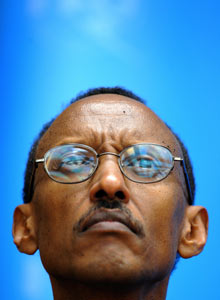 Rwandan president Paul Kagame. Photograph: Fabrice Coffrini/AFP/Getty Images
 Across Rwanda's border with Congo, it is another matter. Kagame's army has as much blood on its hands as any of the myriad of armed groups that have killed and plundered their way through that desperate, vast country. For years the Rwandans got away with it, but the perpetual suffering of the Congolese has begun to erode the moral authority bestowed on Rwanda's leadership by the genocide. Still, Kagame is viewed by many, including his friend Tony Blair, as the hope for the future. He may be. Or he may just be another desperate attempt by the west to latch on to a leader with promise.
Where almost no one looks for moral example any more is South Africa.
Mandela's legacy was squandered over the years, sometimes through the realpolitik of international relations but, more disturbingly, by the authoritarian tendencies of his successor, Thabo Mbeki. Mbeki took over the presidency in 1999, offering the vision of an African renaissance that would not only change how Africa was governed, and the relationship between the people and their rulers, but how the rest of the world saw the continent. South Africa by then had the most progressive constitution in the world, even though Mandela was initially none too happy about the entrenching of gay rights.
A decade later, Mbeki's failed leadership is principally remembered for sacrificing the lives of hundreds of thousands of people while he fiddled around in league with a group of maverick scientists who questioned the causes of Aids and the established methods of keeping HIV-positive people alive. Mbeki's blocking of the life-saving drugs to millions of people was his greatest crime, but his stature was further eroded abroad by his malign manipulation of Zimbabwe's political crisis to help keep Mugabe in power. When he wasn't squandering South Africa's moral authority over Zimbabwe, Mandela's successor was wasting it at the UN security council protecting Burma's military regime.
South Africans have other concerns too, principally Mbeki's legacy of a self-enriching, authoritarian and sometimes corrupt ruling elite, and his undermining of the institutions of South Africa's new democracy to pursue his political enemies and protect friends such as the country's police chief, who was consorting with, and probably taking money from, the mafia and trying to cover up a murder.
Through it all, there has been a steady rise in corruption amid a shameless pursuit of money by political leaders who equate wealth with liberation. As Mbeki's former spokesman, Smuts Ngonyama, famously put it, he himself "didn't join the struggle to stay poor".
It's an uphill task to persuade South Africans that the ANC isn't soft on corruption when the party is putting so much energy into keeping its leader and candidate in April's presidential election, Jacob Zuma, from going on trial for bribery and racketeering. The ANC is shameless in its tolerance of corrupt officials. When Tony Yengeni, the party's former parliamentary chief whip, was convicted of fraud as part of an arms deal, he was carried to the prison gates on the shoulders of ANC officials as if he were a hero.
Among those on hand to cheer him was Baleka Mbete, now South Africa's deputy president. The authorities saw to it that Yengeni served just three months of his three-year sentence, and he is again serving in the highest echelons of the party.
The ANC's answer to an array of revelations of corruption in its ranks has been to abolish the independent investigations unit that brought the prosecutions against Zuma, Yengeni and others. Yet in the midst of these spreading abuses, courageous voices stand out again. A lot more lives would have been lost, and democracy corroded even further, if it hadn't been for a courageous collection of South Africans who struggled against apartheid, but who were prepared to break a taboo and criticise the liberation movement.
Zackie Achmat and his Treatment Action Campaign spoke up for those doomed by Mbeki's Aids policies: poor and working-class black people. Their vigorous agitation, on the streets, through the unions and in the courts, held Mbeki and the ANC up to the light of public scrutiny and accountability in a way that had not happened before. Mbeki's ludicrous pronouncements were ridiculed, his lies challenged, his misrepresentation of statistics exposed. Achmat won the day in the courts, and forced the government to supply the life-saving drugs. But they achieved more than that. They opened the door to other legitimate criticisms of the ANC government, particularly on economic policy and the abuse of power; criticisms that a few years earlier might have been regarded as a betrayal of the liberation struggle. This in turn may have gone a long way to rescuing South African democracy, and it's a trend being seen in other parts of Africa, too. The "big men" failed. The new breed was a letdown.
There is, however, plenty of reason for continued caution. The African Union instinctively leapt to the defence of Sudan's president after he was indicted as a war criminal, and it has just elected the repressive and murderous Libyan leader, Muammar Gaddafi, as its chairman.
It says a lot about the state of the continent's leadership that the world's biggest cash prize, millions of dollars offered by a Sudanese-born British telecommunications entrepreneur, is given to African leaders for giving up office without plundering the national coffers. It is, essentially, a reward for following their constitutional duty.
But perhaps now, bad leaders will matter less than in the past. The growth of civil society, a broader and more critical media, access to the wider world through satellite television, the web and mobile phones, and even, in some cases, privatisation of the economy, are laying the ground for what has so often been lacking in the past. A younger generation is more willing to challenge and demand that governments do what they are elected to do. There are a rising number of voices willing to say no to what is wrong.
But I fear it will take another 20 years to realise the fruits of all that.
• Chris McGreal starts work as the Guardian's new Washington correspondent next week. The Guardian's new Africa correspondent is to be David Smith, at present a senior reporter on the Observer
http://www.guardian.co.uk/world/2009/mar/27/chris-mgreal-africa-final-dispatch
Subscribe to:
Comments (Atom)